DIY FM Radio Soldering Kit - Educational Electronics Project
DIY FM Radio Soldering Kit - Educational Electronics Project
Couldn't load pickup availability
Build it. Tune it. Learn from it.
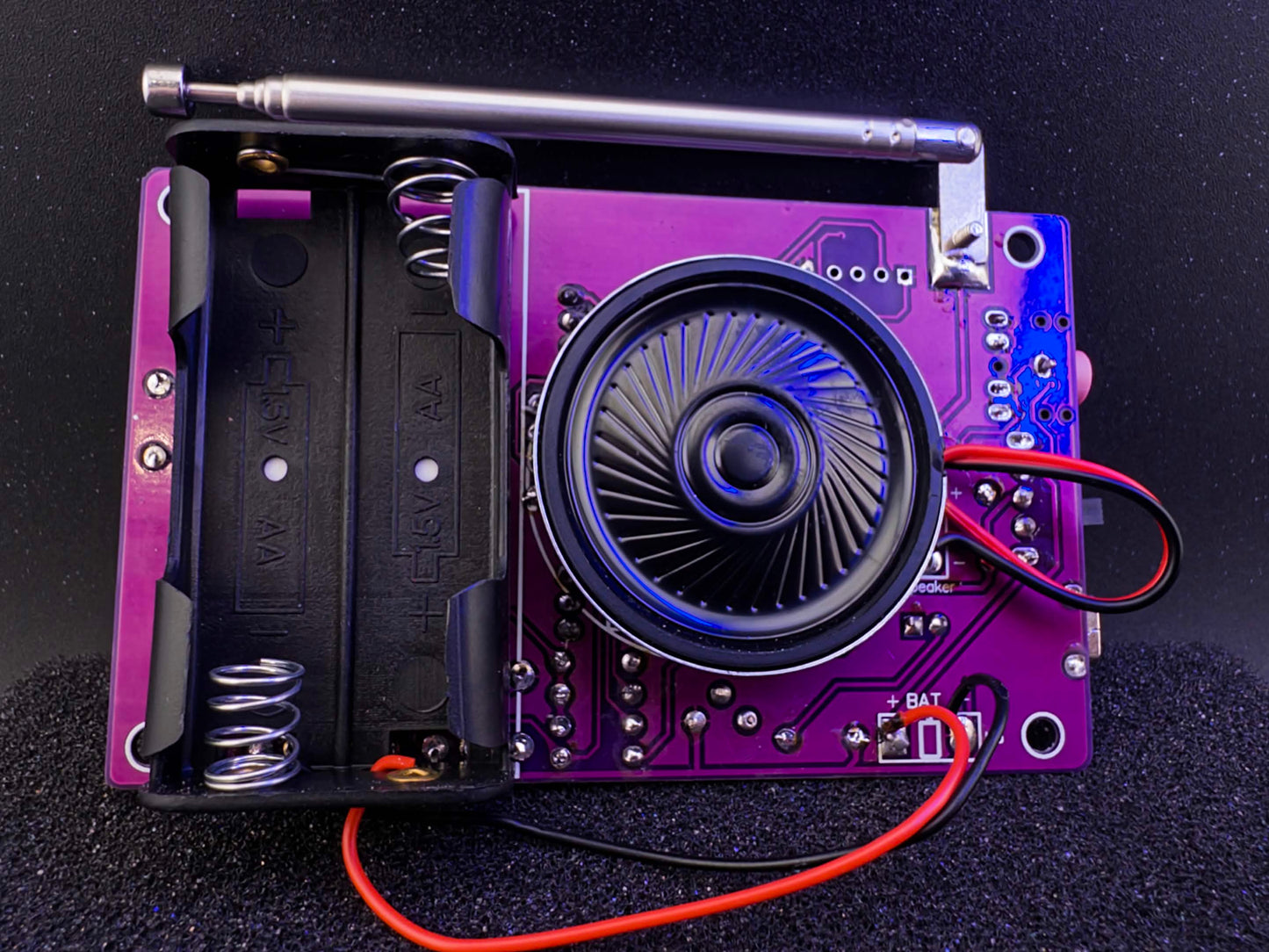
The Vemtech DIY FM Radio Kit is a hands-on electronics project designed for tinkerers, students, makers, and anyone learning to solder. Once assembled, the kit becomes a working FM radio receiver with a clear acrylic case, telescopic antenna, red LED digital frequency display, onboard speaker, headphone output, button controls, and dual power options.
This is not just another little gadget in a box. It is a proper educational soldering project with resistors, capacitors, IC sockets, through-hole components, a few SMD parts, wiring, enclosure assembly, and final testing. By the end, you get something you can actually use, which is far more satisfying than soldering random practice pads into oblivion.
Great for learning
This kit is ideal for beginners who already know the basics of soldering, or ambitious first-timers with patience and adult supervision. It includes a mix of through-hole and surface-mount components, making it a useful bridge between simple beginner kits and more advanced electronics work.
You will practise:
Reading PCB markings and component labels
Identifying resistors, capacitors, ICs, sockets, switches, and connectors
Soldering through-hole components
Carefully soldering small SMD components
Checking polarity and component orientation
Mounting a speaker, antenna, battery holder, and acrylic case
Testing and tuning a finished working circuit
Features
87.0 MHz to 108.0 MHz FM radio receiver
RDA5807M FM receiver module
4-digit red LED frequency display
Telescopic FM antenna
Built-in 0.5W mono speaker output
3.5 mm headphone / AUX output
Button controls for frequency and volume
Potentiometer volume adjustment
Transparent acrylic enclosure
Dual power options: 5V USB or 2 x AA batteries
Compact finished size: approximately 107 x 70 x 23 mm
Controls
V+ / V-: adjust volume
F+ / F-: tune FM frequency
Power switch: turn the unit on or off
Potentiometer: fine volume adjustment using a screwdriver
Power options
The kit can be powered by either 5V USB or 2 x AA batteries.
Do not connect USB power and AA battery power at the same time.
Difficulty
Intermediate beginner.
This kit is suitable for learners who are ready to move beyond the easiest soldering projects. There are several small SMD components, so good lighting, patience, tweezers, and a steady hand are strongly recommended.
Tools required
Soldering iron
Rosin-core electronics solder
Flush cutters
Wire strippers
Phillips screwdriver
Tweezers recommended
Solder wick or solder sucker recommended for SMD cleanup
Tools are not included unless specifically stated in the selected bundle.
Important notes
This is a DIY kit and requires assembly before use.
The kit contains small parts and is not suitable for young children.
Adult supervision is recommended for younger builders.
Soldering irons are hot enough to cause burns. Work carefully.
Pay close attention to component polarity and orientation.
Read the installation manual before starting assembly.
The radio station and volume may need to be adjusted again after powering on.
FM reception quality may vary depending on local signal strength and interference.
Manual
You can view the full installation manual here:
What’s included
FM radio PCB
RDA5807M FM receiver
STC15W404AS MCU
TDA2822M amplifier
74HC595D register
IC sockets
Resistors
Capacitors
Transistors
4-digit red LED display
Toggle switch
Micro USB socket
3.5 mm AUX socket
Push buttons and button caps
Telescopic antenna
0.5W 8Ω speaker
AA battery holder
USB power cable
Acrylic enclosure panels
Mounting screws, nuts, and standoffs
Why we like it
Most beginner soldering kits blink an LED and then retire to a drawer. This one gives you a real, working radio with a visible circuit, physical controls, and a finished acrylic enclosure. It is a neat little desk gadget, but more importantly, it teaches the builder how a real electronic assembly comes together piece by piece.
Share